14 Facts About Iguazu Falls That Will Surprise You
The short answer
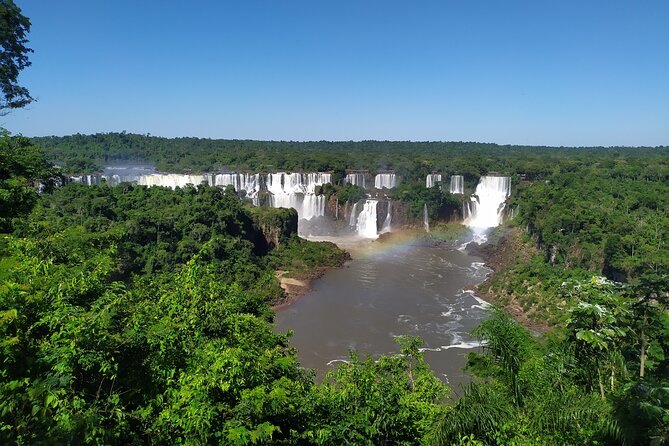
Iguazu is not one waterfall but 275, spread across 2,700 metres of an international border, and in 2026 it ran at five times its historical average — hard enough that a national park took a walkway apart rather than lose it.
1. It is 275 waterfalls, not one
UNESCO's inscription counts 275 separate cascades along the rim. How many you can see at once depends on the flow: in high water they merge into fewer, wider sheets, and in a dry spell some stop altogether.
2. Half the river goes down one chasm
The Garganta del Diablo is 80 to 90 metres wide and 70 to 80 metres deep, and takes roughly half the Iguazú River's entire flow on its own. Everything else is the other half, spread across nearly three kilometres.
3. Argentina has the falls; Brazil has the view
About 80 per cent of the cascades are on the Argentine bank — and because the rim curves, the country with fewer of them is the one you can see all of them from. It is the reason nobody who has done both will tell you one side is enough.
4. There are two national parks, not one
Argentina created Parque Nacional Iguazú in 1934 and Brazil created Parque Nacional do Iguaçu on 10 January 1939. They have never been merged, they have separate authorities and separate tariffs, and you pay both if you cross. The detail is on the national parks page.
5. UNESCO inscribed them two years apart
Argentina's park went onto the World Heritage List in 1984 and Brazil's in 1986 — as two distinct properties rather than one transboundary site.
6. In 2026 the river ran five times its average
The historical mean flow at the falls is about 1.5 million litres a second. On 2 September 2026 the Brazilian park recorded a peak of 8,370,000 litres a second, and by 11 September it was above 8.4 million and still rising.
7. A national park dismantled a walkway to save it
Rather than risk losing the Garganta del Diablo walkway to a flood, Argentina suspended access on 3 August 2026 and began taking it apart, storing the decking and railings at Garganta station until the flow drops. Removal alone was expected to take 30 to 40 days.
Planning around it. No reopening date has been announced. If the Throat is why you are coming, read the Argentine side for what is standing and the helicopter tours for the one view of it nobody can close.
8. There is a bird that flies through the waterfall
Great dusky swifts nest on the wet rock behind the falling water and reach the nests by flying straight through the curtain. They do it in numbers at dusk and at first light, and it is the single most remarkable thing here that is not the water itself.
9. The forest has more than 2,000 kinds of plant in it
The UNESCO record puts over 2,000 species of vascular plant in the surrounding Atlantic Forest, with tapir, giant anteater, howler monkey, ocelot, jaguar and caiman among the animals. What you will meet on a walkway is a coati, and the wildlife page explains why that matters.
10. The name is Guaraní, not Spanish
Iguazú is y and guasu — big water. The Spanish conquistador Álvar Núñez Cabeza de Vaca reached the falls in 1542 and named them the Salto de Santa María. That name lasted about as long as he did.
11. A woman from Buenos Aires paid for the road
Victoria Aguirre funded the track that made the falls reachable at the turn of the twentieth century. The main street of Puerto Iguazú carries her name, as does the building the Argentine park administration works from. The rest is on the history page.
12. It won the Palme d'Or
Roland Joffé's The Mission was filmed here and took the Palme d'Or in 1986 — the same year Brazil's park was inscribed by UNESCO. The opening sequence, a Jesuit sent over the edge lashed to a cross, was shot at these falls.
13. July 2026 was the busiest month in the park's history
The Brazilian side recorded 263,150 visitors in July 2026 and 174,005 in August, its biggest August ever. Most of them were Brazilian and Argentine: 97,761 and 27,685 respectively in August, against 5,106 Italians and 4,529 Spaniards.
14. You cannot fly over the Argentine side
Helicopter flights operate from Foz do Iguaçu only, because Argentina does not permit overflights of its national park. It is a conservation rule about noise, and it is why every aerial photograph you have seen was taken from Brazilian airspace.
15. The two parks are the largest block of Atlantic Forest left
Between them, Argentina's 67,698 hectares and Brazil's 185,262 protect roughly a quarter of a million hectares of Selva Paranense — the biggest surviving piece of a forest that once ran all the way to the Atlantic coast. The waterfall is, in conservation terms, a by-product of protecting that.
16. The ground is bright red, and that is why the river turns brown
Misiones sits on deep laterite soils, and every track and road around the falls is the colour of terracotta. After heavy rain that soil goes into the river, which is why photographs of Iguazu in flood show brown water rather than white — and why the 2026 pictures look so different from the postcards. What the flow does to a visit is on the weather page.
17. Nobody agrees how many waterfalls there are
275 is UNESCO's figure and the one both parks use, but you will see 150, 160 and 300 quoted elsewhere. They are all defensible, because a "waterfall" here is a matter of where one sheet of water stops and the next begins — and that boundary moves with the flow. In a dry month the count goes up as the sheets break apart; in a flood it collapses.
18. The two parks were inscribed for different reasons
Both citations rest on the forest as much as the water. Argentina's 1984 inscription and Brazil's 1986 one describe a subtropical rainforest holding jaguar, tapir and giant anteater, with the waterfall as the feature that made the area worth protecting first. It is why the trails away from the falls are inside the same ticket, and why the wildlife page is not an afterthought.
The numbers in one place
| Measure | Figure |
|---|---|
| Cascades | 275 |
| Height of the rim | ~80 m |
| Width of the rim | ~2,700 m |
| Devil's Throat chasm | 80–90 m wide, 70–80 m deep |
| Mean flow | ~1.5 million litres per second |
| Peak recorded, 2 September 2026 | 8,370,000 litres per second |
| Argentine park | 67,698 ha, created 1934, inscribed 1984 |
| Brazilian park | 185,262 ha, created 1939, inscribed 1986 |
| Plant species | 2,000+ |
Everything above is checked against the two park authorities and the UNESCO record; the practical consequences of the flow figures are on the weather page and the hours and admissions are on plan your visit.
Facts are one thing; standing in the spray is another. Every guided day at the falls, with the park it enters and the fee it carries, is at Iguazu Falls Tours.
See these for yourself
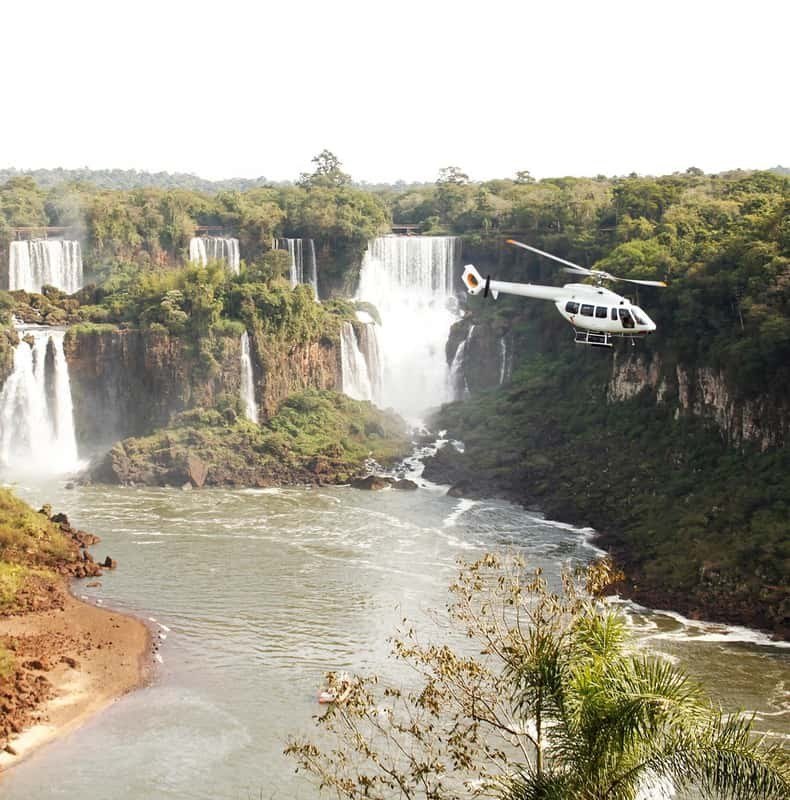
Iguazu Falls 10-Minute Panoramic Helicopter Flight
The only view of the whole horseshoe at once, from Brazilian airspace.
From $253 per person
Check Availability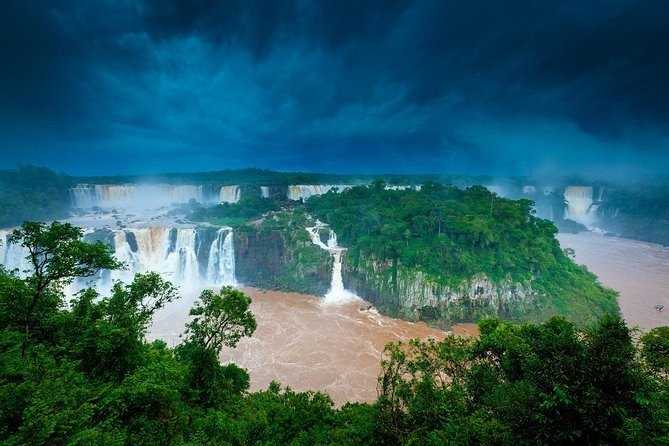
Full Day Iguassu Falls Both Sides - Brazil and Argentina | Iguazu Falls Tour
Both national parks in one day, which is the only way to take in the whole rim.
From $136 per person
Check Availability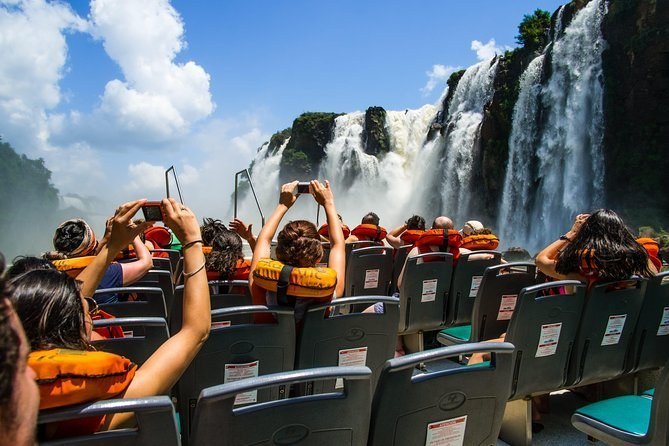
Iguazu Falls Tour, Boat Ride, Train and Safari Truck
The Argentine circuits and a boat into the spray beneath them.
From $159 per person
Check Availability