One Day or Two at Iguazu Falls: Which Is Enough, and What You Lose by Rushing
The short answer
One day can cover both countries and about 60 per cent of what there is to see. Two days covers effectively all of it without rushing, and costs one extra night rather than one extra fare. If you are flying in and out on the same day, take the Argentine side and do not attempt the border.
What one day actually buys you
A single day across both parks is a real product and hundreds of people do it every morning. The shape is fixed by the Brazilian 16:00 close: the Brazilian trail first, the border at lunchtime, and as much of the Argentine side as the afternoon allows.
What you get is the panorama and the upper circuit. What you lose is the lower circuit, the boat, the quieter trails and any margin at all for a queue at immigration.
| One day, both sides | Two days, one park each | |
|---|---|---|
| Park admissions | Both, on the same day | Both, on different days |
| Border crossings | Two, in one day | One, at your own pace |
| Brazilian trail | Yes, rushed | Yes, with the quiet trails |
| Argentine Upper Circuit | Usually | Yes |
| Argentine Lower Circuit | Rarely | Yes |
| A boat under the falls | No | Yes |
| Extra cost | None | One night's accommodation |
| Risk if the weather turns | You lose the whole visit | You lose half of it |
The arithmetic
Work it out rather than take a view. Two admissions are unavoidable either way: AR$60,000 on the Argentine side and R$134 on the Brazilian, whether you spend them on one day or two. The second day costs you one night's accommodation and nothing else — and it converts a rushed pair of half-days into two unhurried ones.
Against that, a second day is a second day of your trip. If Iguazu is one stop on a long route, that is a real price. If you have flown 1,300 kilometres from Buenos Aires to be here, it usually is not.
The border is the variable nobody controls
Crossing between the parks means an immigration post at each end of the Tancredo Neves bridge, and the queue there runs from a few minutes to over an hour with no pattern you can plan around. On a two-day visit that is an inconvenience. On a one-day visit it is the difference between walking a circuit and watching it from the coach.
This is the strongest argument for a guided day that crosses: the paperwork stops being your problem. The practicalities are on how to get to Iguazu Falls.
If you only have one day, pick one country. A full day on the Argentine side beats half-days on both, because it is the side you walk into rather than look at. Reverse that only if the panorama is specifically what you came for.
Who should do one day
- Anyone flying in and out of Buenos Aires on the same day — the timings leave no choice.
- Travellers on a fixed multi-country itinerary with one night here.
- Visitors who want the photograph rather than the walk.
- Anyone for whom a second night is genuinely the binding cost.
Who should do two
- Anyone who wants a boat. There is no version of a one-day crossing that fits one in.
- Families, where the pace is set by the slowest walker.
- Photographers, because the two sides want different hours of the day.
- Anyone visiting between September and February, when a closure or a storm can take an afternoon away.
What a high river does to the decision
In a year like 2026 the calculation shifts. With the Argentine Devil's Throat walkway dismantled since 3 August and the Brazilian walkway closing on high flow — it shut at 13:00 on 11 September with the river above 8.4 million litres a second — a single day carries more risk of missing the one thing you came for. Two days gives the river a second chance to behave. The current state of both is on the weather page.
If you have three days
A third day is the one people are most surprised to find useful. It buys a boat without displacing a circuit, it buys the quiet trails — Poço Preto and Bananeiras on the Brazilian side, the Sendero Macuco on the Argentine — and it buys a second chance at the weather.
It also buys the things around the falls rather than in them: the Three Borders marker in Puerto Iguazú, a helicopter flight from Foz do Iguaçu, and a morning with no timetable at all. What each of those is worth is set out on highlights and activities.
Building the two-day version
Day one: the Brazilian park in the morning, when the trail is quietest, and the afternoon for the Macuco Safari or the bird park. Day two: the Argentine gate at opening, the Lower Circuit while it is cool, the Gran Aventura boat around midday, and the Upper Circuit to finish.
That order puts the steep walking first, the soaking in the middle and the level walking last, and it crosses the border exactly once. Both days are described circuit by circuit in Iguazu Falls circuit by circuit, and the Iguazu Falls guided tours that fit each half are set out beside each other with the park and the gate fee on every card.
What a third country adds, and whether to bother
Paraguay is twenty minutes away across a second bridge, and Ciudad del Este is a shopping city rather than a sight. Several itineraries here add the Three Borders marker in Puerto Iguazú, which shows you all three countries from the Argentine bank in fifteen minutes and costs nothing.
Unless you have a specific reason to cross into Paraguay, the marker is the version of that experience worth your time. It slots into the end of a half-day without displacing anything on highlights and activities, and it is the one stop here that asks nothing of your budget at all.
The verdict, by visitor
- First visit, no time pressure: two days, one park each.
- One night only: one full day in Argentina, and accept that Brazil waits.
- Day trip from Buenos Aires: Argentina, guided, and book the earliest flight.
- Returning visitor: one day in Brazil with a boat, and the quiet trails afterwards.
- Photographers: two days minimum, Brazil in the afternoon and Argentina in the morning.
One day or two, the booking question is the same. Which park does it enter, and is the gate fee in the fare? Both are on every card at Iguazu Falls Tours.
Days that fit either answer
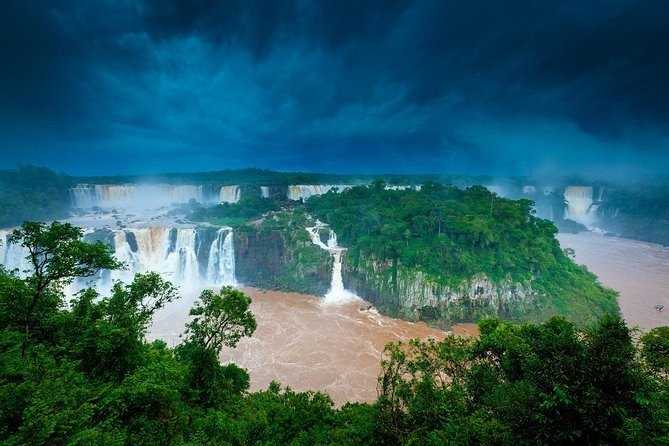
Full Day Iguassu Falls Both Sides - Brazil and Argentina | Iguazu Falls Tour
The shared version of the one-day crossing, with the border handled.
From $136 per person
Check Availability
Iguazu Falls: Private Full-Day Tour Brazil & Argentina 1-Day
The private version, where the order of the two parks bends to the queue.
From $95 per person
Check Availability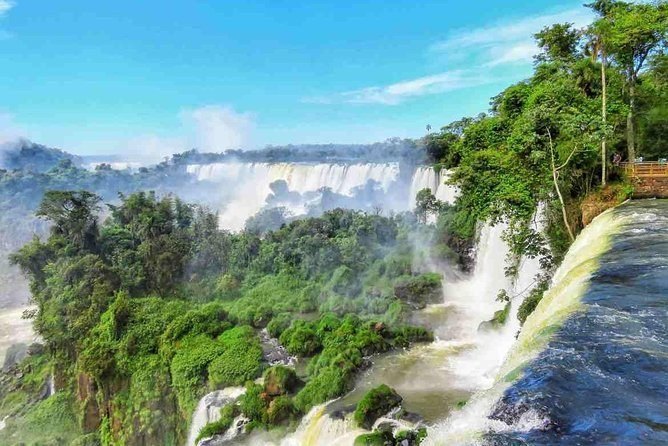
Private Full-Day Iguazu Falls Tour with Airfare from Buenos Aires
One day from Buenos Aires with flights, transfers and the Argentine gate fee.
From $370 per person
Check Availability