Iguazu Falls with Kids: What to See, How Long to Allow and Whether It's Worth It
The short answer
Yes, and the Brazilian side is the easier half: 1.5 km of flat paved trail with buses at both ends. Argentina adds a train children love and a lower circuit with 180 steps. The two things to plan around are the boats, which set a minimum age of 12 or 13, and the coatis, which will take food out of a child's hand.
Is it worth it with children?
It is one of the easiest natural sites of this scale to visit with a family. Everything is outdoors, the walking is on built surfaces, there are trains and buses to break up the distance, and the thing you came to see is visible from the first viewpoint rather than after an hour's climb.
What it is not is short. A full Argentine day runs six to eight hours and there is very little shade on the upper circuit. Plan it as a whole day out rather than an attraction visit.
Which side is easier with a family
| Brazilian side | Argentine side | |
|---|---|---|
| Main walk | 1.5 km paved, gently downhill | ~3.5 km across two circuits |
| Steps | Almost none | ~180 on the Lower Circuit |
| Strollers | Straightforward | Upper Circuit yes, Lower Circuit no |
| Transport inside | Panoramic buses, included | Tren Ecológico, included |
| Time needed | 2–3 hours | 6–8 hours |
| Under-6s | Free | Free |
With small children or a stroller, do Brazil. With children over about eight, Argentina gives them more to do — and the train is usually the part they talk about afterwards. Both are described in full on the Brazilian side and the Argentine side.
The boat, and the age limit
This is the one that causes disappointment, so check it before you book. Both boats that run under the falls set a minimum age — 12 on some listings, 13 on others — and both exclude pregnant travellers and anyone with back, heart or neurological conditions. The Argentine boat is reached by about 300 metres of steps.
If your children are under that age, the rest of the day is unaffected and there is no version of the visit that needs a boat. The alternatives are set out on the boat tours page.
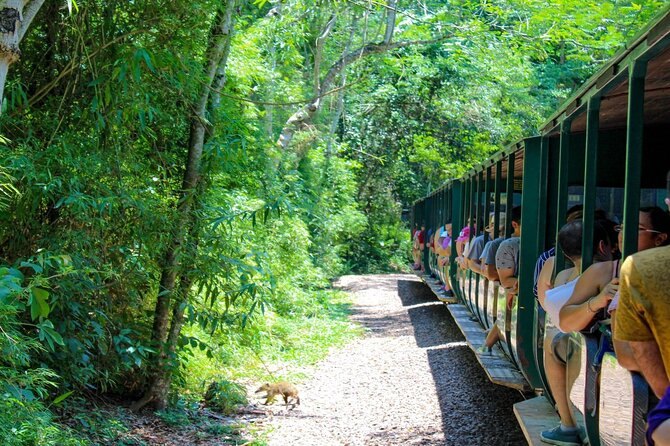
Coatis will approach your children. They work the walkways in bands, they associate people with food, and they bite. Keep snacks sealed and inside a closed bag, eat only in the designated areas, and do not let a child crouch to photograph one. Both parks print the same rule: do not touch or feed them. More on what lives here is on the wildlife page.
What children actually enjoy here
- The train. Open carriages, walking pace, straight through the forest.
- The panoramic buses on the Brazilian side — sit upstairs.
- Getting wet at the end of the Brazilian trail, which happens whether or not you planned it.
- Coatis and toucans, from a sensible distance.
- The jungle truck, where the day includes one — a red-earth track through the forest before the river.
A realistic family day
Be at the gate for opening. Take the first train. Do the harder circuit while everyone is fresh and the air is still cool, break for lunch around noon in a designated eating area, and keep the level walking for the afternoon. Leave before the last hour rather than at it, because tired children and a queue for the train do not combine well.
Budget for a full change of clothes each, regardless of the boat. The spray reaches the walkways.
Book something that refunds. With children, plans change on the morning. Most of the guided days here cancel free up to 24 hours ahead, and the card for each one says so.
What to pack
- Closed shoes with grip, for everyone
- A complete change of clothes per child
- Sun hats and low-impact sunscreen — the Argentine park asks for it
- Insect repellent
- Water, and snacks that seal
- A dry bag or waterproof case for phones
The full list, including the locker rates if you would rather not carry it all, is on plan your visit.
Ages, and what each one gets out of it
Under five
The Brazilian trail with a stroller, and nothing else. The bus ride and the spray at the end are the memory; the walking distance is not.
Five to eight
Brazil comfortably, Argentina with the train doing the work. Skip the Lower Circuit's steps unless everyone is enthusiastic and it is early in the day.
Nine to eleven
Both sides, both Argentine circuits, and real frustration about the boat's age limit. Worth explaining before you arrive rather than at the jetty.
Twelve and over
Everything, including the boat. This is the age at which Iguazu stops being a long walk with a good view and becomes the thing they tell people about.
Two days beats one, with children
A single day across both countries means two park entrances, a border crossing and roughly ten hours of moving, most of it outdoors. It works for adults and it is a great deal to ask of a seven-year-old.
Splitting it — the Brazilian trail one day, the Argentine circuits the next — costs one extra night and removes the part of the day that goes wrong. The arithmetic is set out in one day or two at Iguazu Falls, and the hours for both parks are on plan your visit.
What a family day costs
Both parks charge per adult and both let young children in free — under 6 in Argentina, up to 6 in Brazil — so a family of four with two small children pays two adult admissions on each side. That is AR$60,000 each in Argentina and R$134 each in Brazil for international visitors.
Older children pay the adult rate in both countries. Add parking at AR$12,500 if you have hired a car, lockers if you want to leave dry clothes somewhere, and a boat ticket for anyone over the age limit. The full tariff for both parks is on plan your visit.
Which tours suit a family
Look for three things on a card: hotel pickup, so nobody has to navigate a bus with tired children; a stated group cap, so you know what you are joining; and free cancellation. Private days are worth more here than they are for two adults, because the pace bends to you and the stops happen when they need to.
Travelling with children? Filter for hotel pickup, a stated group cap and free cancellation. All three are on every card at Iguazu Falls Tours.
Family-friendly days at the falls
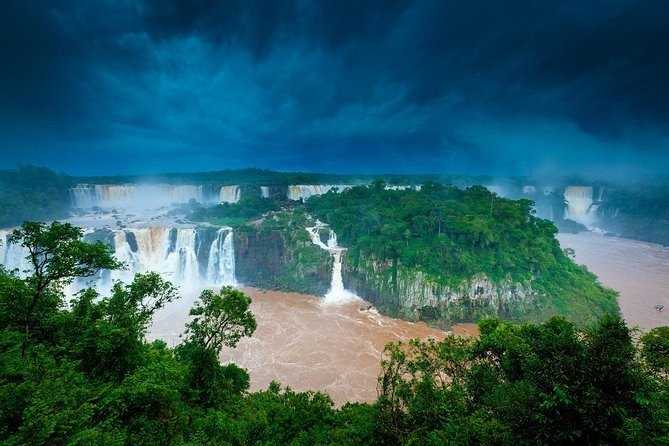
Full Day Iguassu Falls Both Sides - Brazil and Argentina | Iguazu Falls Tour
Both parks with hotel pickup, and the easier Brazilian trail in the morning.
From $136 per person
Check Availability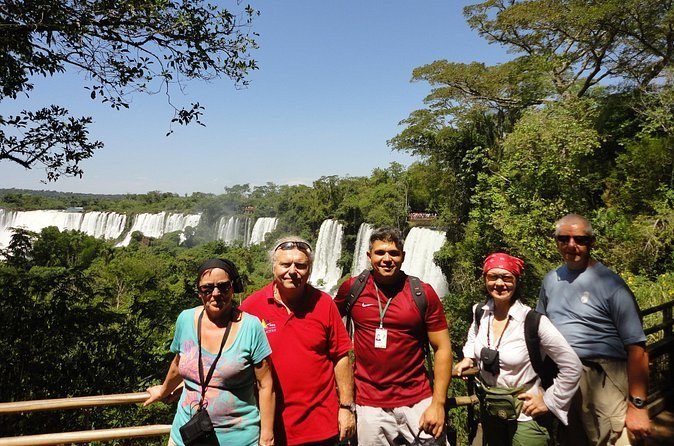
Private Tour Iguazu Falls Argentina + Tri-border
A private day with infant seats and stroller-friendly transport.
From $82 per person
Check Availability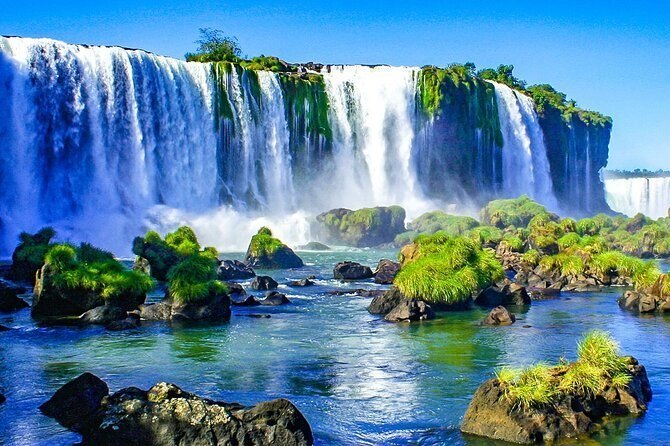
Private 7-Day Classic Argentina Family Tour
A week of private travel built for families, with the falls across two days.
From $3,899 per person
Check Availability